

Choosing a jurisdiction is one of the first strategic decisions in the development of an international business. Yet the decision should never begin with the country itself.
A jurisdiction is not an objective.
It is an instrument that must support the long-term goals of the business, the interests of its owners, the banking strategy, the tax framework and the practical way in which the company will operate.
This distinction separates strategic planning from a purely administrative approach.
At Investmakler, we do not begin by asking where a company should be incorporated.
We begin by understanding what the business is expected to achieve over the next five, ten or several decades.
Only after that do we determine whether Italy is the appropriate jurisdiction.
Italy is one of Europe’s largest economies and an established member of the European Union. It offers access to a substantial domestic market, developed industrial sectors, international logistics, advanced manufacturing, finance, tourism, real estate and one of the world’s strongest premium consumer markets.
For many businesses, Italy represents more than a place of incorporation.
It becomes the jurisdiction where commercial activity is genuinely conducted, contracts are negotiated, business relationships are developed and long-term economic presence is established.
This distinction is increasingly important.
Banks, business partners and public authorities pay attention not only to where a company is registered, but also to whether it has genuine economic substance within the jurisdiction.
The quality of a corporate structure is no longer measured solely by registration documents.
It is measured by the company’s ability to demonstrate a real commercial purpose, transparent ownership, sustainable operations and a coherent long-term strategy.
For this reason, Italy is often most appropriate for businesses that intend to establish genuine economic activity rather than simply obtain a European corporate vehicle.
Typical examples include:
At the same time, Italy is not intended to be a universal solution.
In certain situations, another jurisdiction may better support the objectives of the business.
The quality of the decision depends not on choosing the most recognisable country, but on selecting the jurisdiction that performs the required function within the overall corporate structure.
This principle defines our advisory approach.
We view international corporate structuring as a system in which every element has a clear purpose.
The jurisdiction is one component of that system.
Banking relationships, tax planning, corporate governance, ownership structure, economic substance and the long-term strategy of the shareholders are equally important.
Only when these elements operate together does the corporate structure become sustainable.
At Investmakler, we believe that a jurisdiction should never be chosen because it is popular. It should be selected because it supports the long-term development of the business, aligns with its strategic objectives and remains effective as the company evolves over time.
Registering a company in Italy is most effective when the jurisdiction supports the long-term objectives of the business rather than serving as an end in itself.
Successful international structures are built on strategy, not on the assumption that one country is universally suitable for every project.
For this reason, the first question is never “Why Italy?”
The first question is:
“What is the business expected to achieve?”
Only after understanding the company’s objectives does it become possible to determine whether Italy represents the appropriate jurisdiction.
Italy is often a strong strategic choice for businesses that intend to establish genuine economic activity within the European Union and build long-term commercial relationships with European partners.
Typical examples include:
Practical example.
A company plans to distribute European industrial equipment throughout the European Union.
Its commercial partners, logistics providers and suppliers are located in Italy and neighbouring EU countries.
In this situation, an Italian company may become a natural operational platform for contracts, payments, commercial relationships and long-term business development.
Another example.
An entrepreneur intends to build a hospitality business in Italy.
The project includes acquiring property, employing local staff, working with Italian suppliers and serving international visitors.
Here, the jurisdiction performs a clear commercial function because the business is genuinely connected with the Italian market.
Italy may also be appropriate when the owner plans to combine commercial activity with long-term personal presence in the country.
In such projects, the corporate structure becomes one element of a broader strategy that may include business development, family interests, property ownership and long-term international planning.
At the same time, registration alone does not create business value.
A company does not automatically establish banking relationships, generate commercial activity or provide economic substance simply because it has been incorporated.
Its practical value depends on how effectively the corporate structure supports the business model.
This is why each project should be considered individually.
The same jurisdiction may be highly effective for one company and considerably less suitable for another operating in a different sector or pursuing different strategic objectives.
A well-designed international structure begins with understanding the business, not with selecting the country.
At Investmakler, we believe that the right jurisdiction is the one that naturally supports the company’s commercial activity, banking strategy, tax framework and long-term development. When these elements are aligned, the corporate structure becomes a sustainable foundation for international growth.
Italy offers significant advantages for many international businesses. However, no jurisdiction should be viewed as the right solution for every project.
One of the most common mistakes in international corporate structuring is selecting a country before understanding the commercial objectives of the business.
A jurisdiction should support the business model.
The business should not be forced to adapt to the jurisdiction.
This principle lies at the core of long-term international planning.
Practical example.
A digital services company operates entirely online.
Its management team is located in several countries, clients are based outside the European Union and the business has no commercial activity, personnel or assets in Italy.
In this case, another jurisdiction may provide a more practical and efficient corporate framework.
Another example.
An international trading company operates exclusively between Asia, the Middle East and Africa.
Its suppliers, customers, logistics routes and banking relationships are unrelated to Italy.
Under these circumstances, incorporating an Italian company may introduce additional administrative obligations without creating corresponding commercial value.
Italy also requires a higher level of corporate administration than many entrepreneurs initially expect.
Accounting, taxation, corporate governance, regulatory compliance and ongoing reporting should all be considered before the incorporation process begins.
For businesses with genuine economic activity, these requirements represent a normal part of operating within one of Europe’s largest economies.
For projects seeking only a formal European registration, they may become an unnecessary burden.
It is equally important to understand that a well-established jurisdiction usually applies higher standards of transparency.
Banks, professional advisers and public authorities increasingly expect companies to demonstrate:
These expectations should not be regarded as obstacles.
They form part of a stable and predictable international business environment.
For this reason, the more appropriate question is not:
“Is Italy a good jurisdiction?”
The better question is:
“Is Italy the right jurisdiction for the specific objectives of this business?”
The answer depends on the function that the jurisdiction is expected to perform within the overall corporate structure.
At Investmakler, we do not recommend jurisdictions based on reputation or popularity. We recommend solutions that remain commercially practical, strategically aligned and sustainable for decades as the business continues to grow and evolve.
Business immigration is often misunderstood.
Many people associate it exclusively with relocating to another country, obtaining a residence permit or changing their place of residence.
In reality, international business operates on a much broader level.
For most entrepreneurs, business immigration begins with establishing a sustainable economic presence in the chosen jurisdiction.
It is a process through which a company becomes part of the country’s business environment, develops relationships with banks, suppliers, customers, professional advisers and public authorities, and gradually integrates into the local economy.
This is why company incorporation represents only the beginning of the process.
The next stage is building a corporate structure capable of supporting long-term business development.
In practice, this usually includes:
Practical example.
An entrepreneur establishes a company in Italy to develop an export business.
The company enters into commercial agreements, builds contractual relationships, works with suppliers, complies with Italian regulations and conducts real business operations.
In this situation, the company is not merely a registered legal entity.
It represents a genuine economic presence within Italy.
Another example.
An international group establishes its European office in Italy to coordinate relationships with manufacturers, distributors and customers across the European market.
Here, business immigration becomes part of a broader international expansion strategy rather than an objective in itself.
Banks and public authorities increasingly focus on the economic substance of a business.
They consider not only the registration documents, but also whether the company conducts genuine commercial activity, where management decisions are made, the nature of its commercial operations and whether there is a legitimate business purpose behind the corporate structure.
For this reason, the concept of economic substance has become one of the fundamental principles of international corporate planning.
The stronger the commercial activity carried out through the company, the more sustainable its position becomes within the jurisdiction and the greater the level of confidence from banks, business partners and regulatory authorities.
Business immigration should therefore be viewed as the establishment of a functioning business ecosystem rather than a formal registration process.
At Investmakler, the foundation of our model is the creation of sustainable economic presence that becomes an integral part of the client’s long-term international business strategy.
Company registration in Italy is not an isolated legal procedure.
It is one stage in the development of an international corporate structure.
For this reason, before preparing incorporation documents, it is important to understand how the company is expected to operate after registration.
In practice, the incorporation of a legal entity marks the beginning of a broader process that includes corporate governance, banking relationships, tax planning and the long-term development of the business.
Several key questions should be considered before the registration process begins.
1. The Purpose and Objectives of the Company
The first question concerns the company’s purpose and objectives.
The company may be established to enter the European market, expand international trade, develop manufacturing operations, create a regional office, manage investments, work with Italian partners or support a business immigration strategy.
The more clearly these objectives are defined, the easier it becomes to design the appropriate corporate structure.
2. The Legal Form
Italy offers several legal forms for conducting business.
| Form | Suitable For | Key Features |
|---|---|---|
| S.r.l. | Small and medium-sized businesses | Flexible form, limited number of participants, most common |
| S.p.A. | Large-scale projects, institutional investors | Higher capital requirement, more complex corporate governance |
| Branch | Existing foreign businesses | Presence without a separate legal entity, different tax implications |
| Ditta individuale | Local sole traders | Not suitable for international tax and corporate structuring |
The choice depends on the number of shareholders, the scale of the business, the corporate governance model, capital requirements and the long-term development strategy.
The legal form should therefore be selected according to the objectives of the business rather than the simplicity of the incorporation process.
3. The Corporate Structure
Before registration, it is important to understand who the shareholders will be, who will manage the company, how key corporate decisions will be made and what future adjustments to the ownership structure may become necessary.
If the long-term strategy includes attracting investors, adding new shareholders or creating a group of companies, these factors should be considered from the outset.
4. The Banking Strategy
One of the most common mistakes is to address banking only after the company has been incorporated.
In practice, the banking strategy should be developed much earlier.
It is important to understand which banks are prepared to work with the proposed business model, what documentation will be required during compliance procedures and how the source of funds will be demonstrated.
A well-prepared banking strategy significantly improves the predictability of the entire project.
5. The Tax Framework
Tax planning should also be understood before registration.
This involves not only the taxation of the company itself, but also the tax position of its shareholders, profit distribution, international transactions and potential tax implications in other jurisdictions.
A comprehensive approach helps prevent situations where the corporate structure proves to be considerably less effective than originally anticipated.
6. The Long-Term Development Strategy
Company registration is not a short-term decision.
For this reason, it is advisable to understand how the business is expected to develop over the next five, ten or several decades.
Will the company expand into new markets?
Will external investment be required?
Will additional business activities be introduced?
Will the corporate structure need to evolve across multiple jurisdictions?
Answers to these questions make it possible to establish a corporate model that remains effective as the business grows.
The foundation of our model is the creation of international corporate structures in which company registration becomes a natural continuation of the business strategy rather than its starting point. This approach enables businesses to build corporate solutions that remain effective for decades.
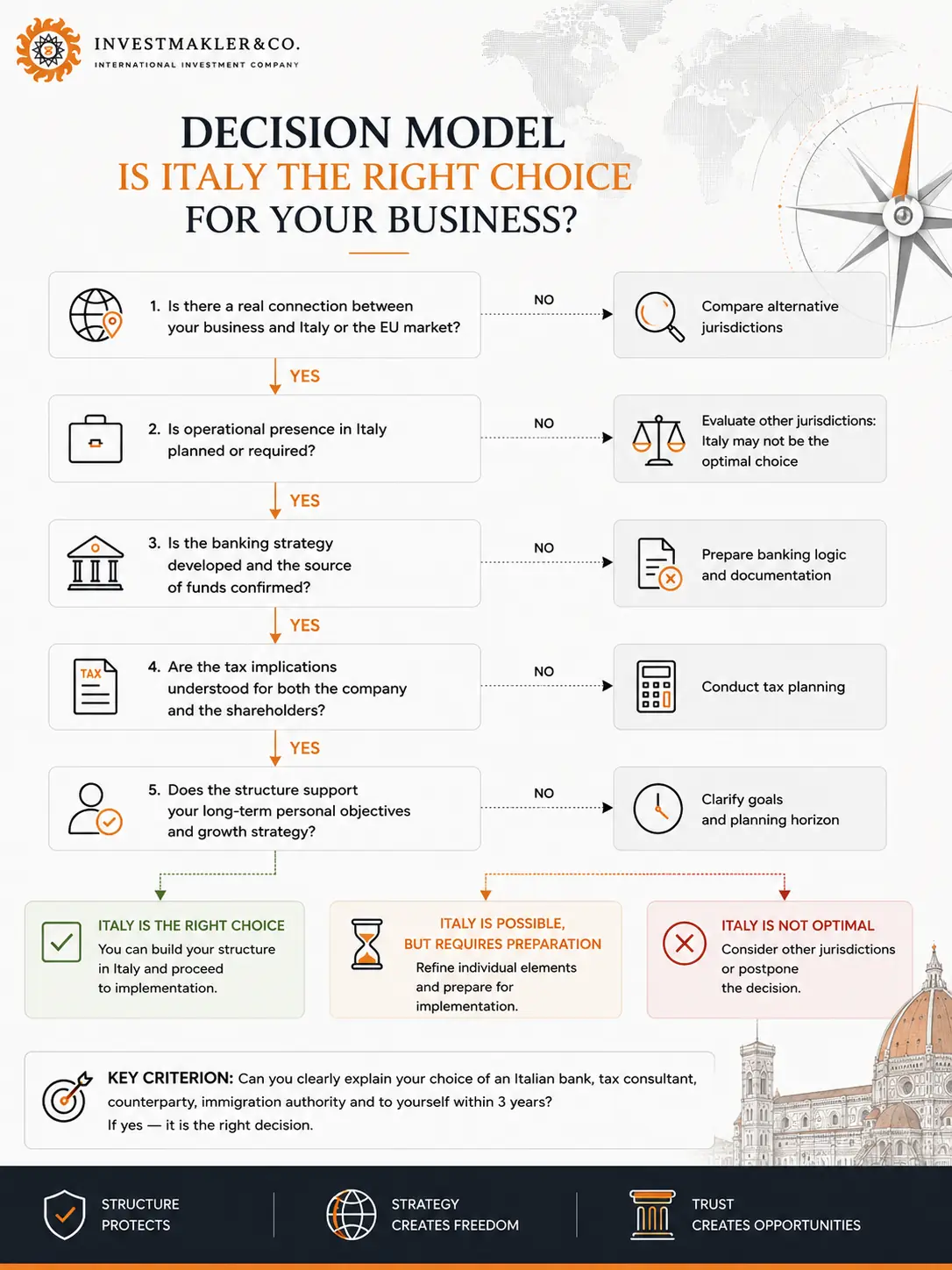
Following the incorporation of a company, one of the most important stages is establishing its banking infrastructure.
A company may be properly incorporated under Italian law, yet this alone does not ensure that it is ready to operate.
Banks independently assess the ownership structure, business model, source of funds, expected transactions, countries involved in future payments and the company’s genuine economic connection with Italy.
A bank does not open an account simply because a company has been registered.
Its decision is based on an independent assessment of both the client and the overall corporate structure.
For this reason, the banking strategy should be developed before the incorporation process begins rather than afterwards.
Banks do not assess individual documents in isolation.
They evaluate whether the entire business model is coherent, transparent and commercially credible.
If an Italian company has shareholders, suppliers, customers and financial flows located in other jurisdictions, the purpose of the Italian entity should be clearly understood.
Such a structure may be entirely appropriate.
However, its commercial function should be logical and well supported.
Incorporation within the European Union does not automatically provide access to the banking system.
Banks need to understand:
A simple statement that the company is registered within the European Union is not sufficient.
A considerably stronger profile is presented by a business that works with Italian suppliers, operates local assets, develops commercial relationships, manufactures products, employs staff or serves European customers.
In these circumstances, the purpose of the jurisdiction becomes both practical and commercially credible.
Verification of the source of funds is one of the central elements of banking compliance.
It is important to understand not only where the capital originated but also the complete path through which the funds reached the company.
The consistency of this information is critical.
Banks should clearly understand how the funds were generated, where they were held, through which accounts they passed and why they are being transferred to the Italian company.
If this process cannot be documented, the compliance review may become significantly more complex.
The description of the company’s activities should be specific.
General expressions such as international trade, consulting or investment services provide very little information on their own.
Banks seek to understand:
The more precisely the business model is presented, the more understandable the banking profile becomes.
Any inconsistency between the declared activities and actual commercial operations may create additional compliance concerns.
Simple ownership structures are generally easier for banks to understand.
For example:
one shareholder, one director, a transparent source of funds and a clearly defined business activity.
More sophisticated structures may also be entirely appropriate provided they have a legitimate commercial purpose.
Complexity is not, in itself, a problem.
Lack of commercial logic is.
For an Italian company, it is important to understand how its economic presence within the country will be established.
This may include:
Economic presence does not necessarily require substantial infrastructure from the first day.
However, the company should have a clear and demonstrable connection with Italy.
A structure created solely for formal purposes becomes significantly weaker not only from a banking perspective but also within the broader commercial environment.
The exact requirements differ between financial institutions and business sectors.
the corporate structure should be transparent, well documented and commercially consistent.
Compliance should not be viewed as a technical procedure that follows incorporation.
It is an assessment of the credibility and sustainability of the entire business model.
If a company cannot clearly explain its source of funds, commercial activity, ownership structure or the purpose of operating in Italy, the issue extends beyond banking.
It indicates that the corporate structure itself requires further development.
For this reason, compliance should be considered an integral part of the project’s architecture rather than a separate administrative stage.
The foundation of our model is the integration of the corporate structure, banking strategy, source of funds and commercial activity into one coherent system. Such a system should be transparent, commercially logical and understandable to banks, shareholders, counterparties and professional advisers throughout the entire life of the business.
The tax framework is one of the key components of any international corporate structure.
It plays a significant role not only during the incorporation process but throughout the company’s future development.
One of the most common mistakes is to address tax planning only after the company has been established.
In practice, it is considerably more effective to understand the tax framework before the incorporation process begins.
This makes it possible to develop a structure that supports the objectives of the business and helps prevent future adjustments.
Each of these elements influences the long-term performance of the corporate structure.
For this reason, the tax framework should be viewed as an integral part of the overall business strategy rather than a separate accounting function.
The Company and Its Shareholders
A company’s tax position cannot be considered independently of its shareholders.
In many situations, it is equally important to understand the tax position of the owners, directors, investors and other participants within the corporate structure.
This becomes particularly relevant when business activities extend across multiple jurisdictions.
A professional approach therefore requires an understanding of the entire structure rather than its individual components.
Where a company intends to work with international counterparties, the tax framework should reflect the expected geography of future business.
It is important to understand:
The more coherent the financial model, the easier it becomes for banks, auditors, tax advisers and business partners to understand the structure.
A corporate structure should remain effective well beyond the incorporation stage.
It is important to understand how it will operate when new business activities are introduced, additional companies are established, investors join the project or international expansion takes place.
When future growth is considered from the outset, both the corporate structure and the tax framework can be developed in a way that preserves their effectiveness without requiring regular restructuring.
This approach helps reduce future administrative costs, organisational complexity and unnecessary tax risks.
International tax planning does not offer universal solutions.
A structure that performs well for a manufacturing business may be considerably less effective for international trading, investment activities, technology companies or family-owned enterprises.
For this reason, every tax framework should be based on:
Only an individual approach allows the creation of a structure capable of remaining effective for many years.
The Tax Framework as Part of the Business Strategy
Modern international business views taxation as far more than the calculation of tax liabilities.
The tax framework forms part of the overall business architecture.
It should be integrated with the corporate structure, banking strategy, international cash flows, commercial operations and the long-term interests of the shareholders.
Only then does the company become a sustainable international structure capable of supporting long-term business development.
Italy is best understood through the function it performs within an international corporate structure.
The same jurisdiction may be an excellent choice for a manufacturing business, a logical foundation for a hospitality project and an unnecessary solution for a fully remote digital company.
The key question is not whether Italy is an attractive jurisdiction.
It is whether Italy creates practical value for a specific business model.
The following examples illustrate common commercial scenarios.
They are not universal recommendations.
Every project requires an understanding of its ownership structure, banking strategy, source of funds, tax framework and long-term business objectives.
8.1. Manufacturing and Industrial Businesses
Italy is particularly well suited to businesses that require a genuine operational presence within the country.
Typical examples include:
In these situations, an Italian company performs a clear commercial function.
It enters into contracts, works with suppliers, employs personnel, manages production and develops long-term business relationships.
The connection between the jurisdiction and the commercial activity is straightforward.
Company registration provides the legal foundation.
It does not replace business planning.
8.2. International Trade, Import and Distribution
Italy may also be an effective jurisdiction for businesses engaged in international trade.
This is particularly relevant where the company intends to:
In these projects, the banking strategy becomes especially important.
An international trading business should demonstrate not only legal compliance but also commercial credibility.
8.3. Hospitality, Tourism and Food Services
Where business activities take place physically in Italy, an Italian company becomes a natural part of the overall structure.
Typical projects include:
If the project also supports a business immigration strategy, commercial activity should be genuine and capable of being demonstrated in practice.
The company should never exist solely as a formal mechanism for relocation.
8.4. Real Estate and Investment Projects
A company may serve as the vehicle for owning assets, managing projects, attracting investors or operating commercial property.
However, not every investment requires a separate legal entity.
These objectives influence the ownership structure, banking strategy, tax framework and long-term management model.
8.5. Design, Fashion and Creative Industries
Italy remains one of the world’s leading markets for design, fashion, luxury goods and creative industries.
An Italian company may strengthen commercial relationships with:
However, an Italian address alone does not create commercial value.
The corporate structure should be supported by genuine partnerships, manufacturing, contractual relationships, product development or market expansion.
Commercial substance always carries greater value than formal registration.
8.6. Technology, Consulting and Digital Services
Technology companies, consulting firms and digital businesses require a more individual assessment.
If the business is entirely remote, management is distributed internationally and no genuine commercial connection with Italy exists, another jurisdiction may prove more practical.
In these cases, greater importance is often placed on:
The jurisdiction should support the business rather than create unnecessary administrative complexity.
8.7. Family Business and Long-Term International Presence
Another important scenario involves families planning both business expansion and long-term international presence.
In these situations, the company becomes one component of a much broader international strategy.
Corporate decisions influence not only the business itself but also the family’s long-term interests and future generations.
8.8. Entering the European Union Market
Italy may serve as an effective gateway to the European Union for companies established outside Europe.
This is particularly relevant for:
An Italian company may support distribution, contractual relationships, participation in trade exhibitions, local partnerships and long-term market development.
Nevertheless, Italy should not be selected automatically.
For some industrial projects, Germany may provide a stronger platform.
For logistics, Poland may be more practical.
For digital businesses, another jurisdiction may better support the commercial model.
The point of entry should always reflect the practical needs of the business.
8.9. Joint Ventures with Italian Partners
An Italian company may also provide the legal framework for cooperation with local manufacturers, developers, distributors, investors or commercial partners.
The company itself does not eliminate partnership risks.
It should establish a transparent and balanced framework for long-term cooperation.
Where these answers form one coherent business model, Italy may become an effective long-term jurisdiction.
Where the commercial purpose remains unclear, it is generally advisable to complete the strategic planning before proceeding with incorporation.
The foundation of our model is not adapting the business to a pre-selected jurisdiction. It is identifying the jurisdiction that naturally supports the business model, banking strategy, shareholders’ interests and long-term international development.
| Jurisdiction | Key Strengths | When to Consider Instead of Italy |
|---|---|---|
| Germany | Manufacturing, B2B, engineering, logistics | Industrial or highly technical businesses |
| Switzerland | Private capital, banking, family wealth planning | Asset management, holding structures |
| UAE | International hub, trading, tax optimization | No requirement for physical presence in the EU |
| Estonia | Digital administration, IT, freelancing | Fully remote digital business models |
| Cyprus | Holdings, IT, investments, intellectual property | Passive structures, IP tax planning |
| Poland | Logistics, manufacturing, entry to the EU market | Lower entry costs for the European market |
| Luxembourg | Investment funds, finance, asset management | Complex financial structures, funds |
| Malta | Services, digital, licensed operations | Specialised service-oriented business models |
Italy should not be considered in isolation.
It should be evaluated alongside other jurisdictions that may perform a similar function within an international corporate structure.
One jurisdiction may be better suited to manufacturing, another to digital business, another to holding structures, private wealth management or international investment.
The objective is not to determine which country is generally “better.”
The objective is to understand which jurisdiction most accurately supports the company’s business model, banking strategy, tax framework and long-term objectives.
Germany is widely recognised as one of Europe’s strongest jurisdictions for manufacturing, engineering, industrial production, logistics and technology.
A German company is often associated with operational discipline, industrial capability and long-term corporate stability.
Italy performs a different role.
It is frequently the stronger choice for businesses connected with:
Germany often provides a stronger platform for industrial B2B operations.
Italy may be more appropriate where the business combines commercial activity with local production, market presence or long-term personal involvement.
Switzerland occupies a distinct position in international business.
It is often associated with private wealth, holding structures, family offices, international asset management and sophisticated corporate planning.
Switzerland may represent the stronger solution where the principal objective involves:
Italy serves a different function.
Where commercial activity is genuinely carried out in Italy, an Italian operating company is often the more natural solution.
In larger international structures, Italy may perform the operational role, while Switzerland supports ownership, investment or strategic management.
Such structures require careful coordination between corporate governance, banking, taxation and commercial substance.
The United Arab Emirates has become one of the world’s leading international business hubs.
It is frequently selected for:
Italy addresses a different set of commercial objectives.
It may be the stronger choice where the business requires:
The UAE often functions as an international commercial platform.
Italy provides the foundation for operating within one of Europe’s largest domestic economies.
Estonia is well known for its digital business environment and efficient corporate administration.
It is frequently chosen by:
Italy becomes more relevant where the business requires physical economic presence.
This may include:
Estonia offers administrative efficiency.
Italy offers commercial presence within a major European economy.
Italy may represent the stronger choice where business operations are physically connected with the country.
Manufacturing, hospitality, real estate, retail operations and business immigration strategies generally require an operating company located where commercial activity actually takes place.
In more sophisticated international structures, Cyprus may perform a holding function while Italy serves as the operational company.
Such arrangements should always be commercially justified and supported by genuine economic substance.
Poland has become an important operational centre for Central and Eastern Europe.
It is frequently selected for:
Italy offers different advantages.
It is particularly strong where the business is connected with:
Poland may provide an efficient regional operating base.
Italy often becomes the preferred jurisdiction where direct access to the Italian market is central to the business strategy.
It is generally appropriate for larger international projects supported by experienced professional advisers.
For many operating businesses, Luxembourg may represent an unnecessarily sophisticated solution.
Italy is often more suitable where the business involves genuine commercial activity, operational management, employees, customers or physical assets.
Luxembourg primarily addresses investment architecture.
Italy supports operational business.
Malta occupies a specialised position within international corporate planning.
It is frequently considered for certain regulated industries, international services and cross-border corporate structures.
Malta may be appropriate for highly specialised business models.
Italy provides a broader operational platform for long-term commercial activity.
The Strategic Perspective
Another jurisdiction may be more appropriate where the principal objective involves:
The objective is never to identify the most prestigious jurisdiction.
The objective is to identify the jurisdiction that performs the correct function within the overall corporate structure.
The foundation of our model is to begin with the business rather than the jurisdiction. Only after understanding the commercial objectives, banking strategy, tax framework and long-term development plan do we determine which jurisdiction will provide the strongest foundation for sustainable international growth.
Most difficulties in international corporate structuring arise not because of the jurisdiction itself, but because decisions are made in the wrong sequence.
A country is selected first, the company is incorporated afterwards, and only then do business owners begin to consider banking, taxation, compliance and commercial operations.
As a result, the legal entity exists, yet the overall structure does not properly support the business.
The following are among the most common mistakes that can often be prevented before the incorporation process begins.
10.1. Choosing Italy Simply Because It Is Part of the European Union
The statement “We need a company in the EU” is too broad to support a strategic decision.
Italy, Germany, Poland, Estonia, Cyprus and Malta are all members of the European Union.
However, they perform different functions within international corporate structures.
Italy is most effective where the business has a genuine commercial connection with the country.
Without such a connection, European registration alone rarely creates long-term value.
10.2. Beginning with Incorporation Instead of Corporate Architecture
Company registration is a legal procedure.
Corporate architecture is a business decision.
Only after these elements have been established should the legal entity be created.
A well-designed structure always precedes incorporation.
10.3. Leaving Banking Until After Registration
Another common mistake is to consider banking only after the company has been incorporated.
This approach often limits available options.
Banks assess considerably more than incorporation documents.
If the banking strategy has not been developed beforehand, the corporate structure may require unnecessary adjustments later.
Planning the banking strategy at the beginning significantly improves the predictability of the entire project.
10.4. Building the Structure Around Tax Alone
Taxation is important.
However, it should never become the only reason for selecting a jurisdiction.
A sustainable corporate structure also depends on:
A structure created solely for tax reasons may prove difficult to maintain, expensive to administer or commercially impractical.
The tax framework should support the business.
It should never replace it.
10.5. Treating Business Immigration as Relocation Alone
Business immigration involves considerably more than moving to another country.
It is based on establishing genuine economic presence.
This includes:
Where a company exists only as a formal mechanism for relocation, the structure is unlikely to appear sustainable from the perspective of banks, professional advisers or regulatory authorities.
A successful business immigration strategy grows naturally from a genuine commercial project.
10.6. Ignoring the Shareholder’s Personal Tax Position
The company and its shareholders should never be analysed separately.
Where an owner intends to relocate to Italy, manage the company locally or establish long-term residence, personal taxation may become as important as corporate taxation.
It is therefore advisable to understand:
Corporate planning and personal planning should always support one another.
10.7. Creating a Company Without Genuine Economic Substance
Every company should perform a clear commercial function.
This function may involve:
If the company has no genuine commercial connection with Italy, the reason for selecting the jurisdiction should be clearly understood.
Banks and business partners increasingly expect economic substance rather than formal registration.
10.8. Designing the Company Only for Today’s Needs
Corporate structures should not be designed solely for the first stage of the business.
It is important to understand:
A structure that anticipates growth usually remains effective for significantly longer.
10.9. Underestimating Long-Term Administration
Incorporation is only the beginning.
Every company requires ongoing administration.
This may include:
Understanding the long-term cost of maintaining the structure is often more important than understanding the incorporation cost alone.
10.10. Failing to Compare Italy with Alternative Jurisdictions
Italy may indeed represent the strongest solution.
However, this conclusion should follow comparison rather than assumption.
For a particular project, it may be useful to understand:
Comparison strengthens a decision.
It does not weaken it.
10.11. Expecting Guarantees Where Decisions Belong to Third Parties
No strategic adviser can guarantee the decisions of a bank, a public authority or future legislative developments.
Final decisions, however, always remain with the relevant institution.
Professional advisory services are based on reducing risk rather than promising certainty.
10.12. Treating Incorporation as the Final Objective
A company is not the objective.
It is a business instrument.
The real objective is to establish a sustainable international structure that integrates:
Only then does incorporation become part of a functioning international business rather than an isolated legal event.
The foundation of our model is not to complete the incorporation process, but to build international corporate structures that remain commercially, operationally, banking-wise and strategically effective for decades.
Selecting Italy should be the outcome of a structured decision-making process rather than the starting point of an international business project.
Company registration is a legal instrument.
Before incorporation begins, it is important to understand the role Italy is expected to play within the overall corporate structure and why this jurisdiction supports the long-term objectives of the business.
A structured decision-making framework helps prevent most strategic mistakes before the incorporation process even starts.
Why is the company being established?
The answer may include:
The clearer the company’s objectives, the easier it becomes to identify the jurisdiction that best supports them.
The next question is equally important:
Why Italy?
A meaningful commercial connection should exist between the business and the jurisdiction.
This connection may include:
If no such connection exists, it is important to understand the commercial function that the Italian company is expected to perform.
The jurisdiction should become a logical extension of the business model.
The more clearly the business model is defined, the more sustainable the corporate structure becomes.
The banking process begins long before the company is incorporated.
It is important to understand:
Developing the banking strategy at an early stage significantly improves the predictability of the project.
The tax framework should reinforce the company’s long-term commercial strategy.
Where the project includes business immigration or long-term international presence, the owner’s personal strategy becomes part of the overall corporate structure.
It is important to understand:
The company and its shareholders should be viewed as components of one integrated system.
Before making a final decision, it is advisable to compare Italy with other jurisdictions that may better support the project’s objectives.
Comparison strengthens strategic decision-making.
It ensures that the selected jurisdiction genuinely supports the business rather than simply appearing attractive.
Company registration should support not only today’s objectives but also future growth.
It is important to understand:
Answers to these questions help establish a corporate model capable of remaining effective throughout the company’s long-term development.
The Final Decision
Once each stage has been completed, three possible conclusions generally emerge.
First.
Italy fully supports the commercial objectives of the business.
Second.
Italy may become the right jurisdiction after further development of the corporate, banking or tax structure.
Third.
Another jurisdiction is better suited to the project’s long-term strategy.
In every case, the objective remains the same.
The decision is based on understanding rather than assumption.
The jurisdiction is selected not because it is well known, but because it performs the right function within a sustainable international corporate structure.
The foundation of our model is to make jurisdictional decisions only after understanding the company’s objectives, banking strategy, tax framework, shareholders’ interests and long-term development plan. This approach enables us to build international corporate structures that remain commercially effective and strategically relevant for decades.

In many cases, certain stages of the incorporation process can be completed remotely. However, the procedure depends on the chosen legal form, the ownership structure, the applicable legal requirements and the specific objectives of the project. Before starting the process, it is advisable to understand the most appropriate registration procedure for the particular corporate structure.
No. Incorporating a company does not automatically grant the right to obtain a residence permit in Italy. Where the project includes a business immigration strategy, it is important to understand the relevant immigration requirements and align the corporate structure with the shareholder’s long-term personal objectives.
There is no universal answer. The appropriate legal form depends on the company’s objectives, the number of shareholders, the corporate governance model, capital requirements, the nature of the business and the long-term development strategy. For this reason, the legal structure should be determined only after the overall corporate model has been developed.
Each financial institution makes its own independent decision. Following incorporation, the company will normally undergo compliance procedures during which the bank reviews the ownership structure, source of funds, business model, anticipated transactions and the company’s economic connection with Italy. Thorough preparation significantly improves the predictability of the banking process.
The answer depends on the nature of the business. For certain business models, maintaining a physical office is a natural part of commercial operations. In other situations, another form of economic presence may be sufficient, provided it satisfies legal requirements, banking expectations and the practical needs of the business.
Yes. Italian corporate legislation allows certain legal forms to be established with a single shareholder. The ownership structure and management model should nevertheless remain consistent with both legal requirements and the company’s long-term objectives.
Yes, where such a structure supports the overall business strategy. The decision should be based on an understanding of the tax framework, corporate architecture, banking strategy and the long-term objectives of the shareholders.
In many cases, yes. This is particularly true where the business works with European manufacturers, suppliers, customers or logistics networks. Before incorporation, it is important to understand the expected trading geography, banking strategy and tax implications.
Yes, such opportunities may exist. However, before proceeding, it is advisable to understand the company’s history, existing obligations, corporate documentation, tax position and any associated risks. In many situations, incorporating a new company provides greater transparency and predictability.
The documentation depends on the nature of the project. Typically, the process involves identification documents for shareholders, information regarding the proposed business activities, corporate documentation and any additional documents required by Italian legislation or professional advisers.
The timeframe depends on the chosen legal form, the quality of the documentation provided, the complexity of the project and current administrative procedures. For this reason, a realistic timeline can usually be determined only after the proposed corporate structure has been reviewed.
Yes. However, such changes may affect corporate governance, banking relationships, the tax framework and administrative procedures. For this reason, it is generally advisable to design the long-term corporate structure before incorporation takes place.
Yes, where the company forms part of a broader long-term family strategy. These projects often involve corporate planning, wealth management, succession planning, ownership of assets and the future development of the business across generations.
The answer depends on the legal structure, applicable regulations and the specific characteristics of the project. Certain procedures may require the personal presence of the shareholder or authorised representatives.
Yes. Italian corporate legislation generally allows changes to the company’s management. However, such changes may influence banking relationships, corporate governance and internal corporate documentation.
Yes. An Italian company may operate internationally, provided its activities comply with applicable legislation, banking requirements, tax obligations and the principle of genuine economic substance.
Yes. An Italian company may acquire and manage real estate where such ownership supports the objectives of the project and complies with applicable legislation. Before incorporation, it is advisable to understand the long-term ownership structure and the associated tax implications.
Yes. Where the corporate structure has been designed with future growth in mind, admitting new investors or shareholders can usually be accomplished more efficiently. For this reason, future expansion should be considered during the initial planning stage.
For long-term international business, the quality of the corporate structure is considerably more important. A fast incorporation process cannot compensate for weaknesses in corporate governance, banking strategy or the tax framework. Careful preparation creates structures capable of supporting sustainable business development for many years.
The process should begin neither with selecting a jurisdiction nor with preparing incorporation documents. The first stage is understanding the company’s objectives, business development strategy, banking requirements, tax framework and the long-term interests of the shareholders. Only then does it become possible to determine whether Italy is the appropriate jurisdiction for the project. The foundation of our model is to understand the architecture of the future business before incorporating the company. This approach enables the development of international corporate structures that remain commercially effective, strategically relevant and sustainable for decades.
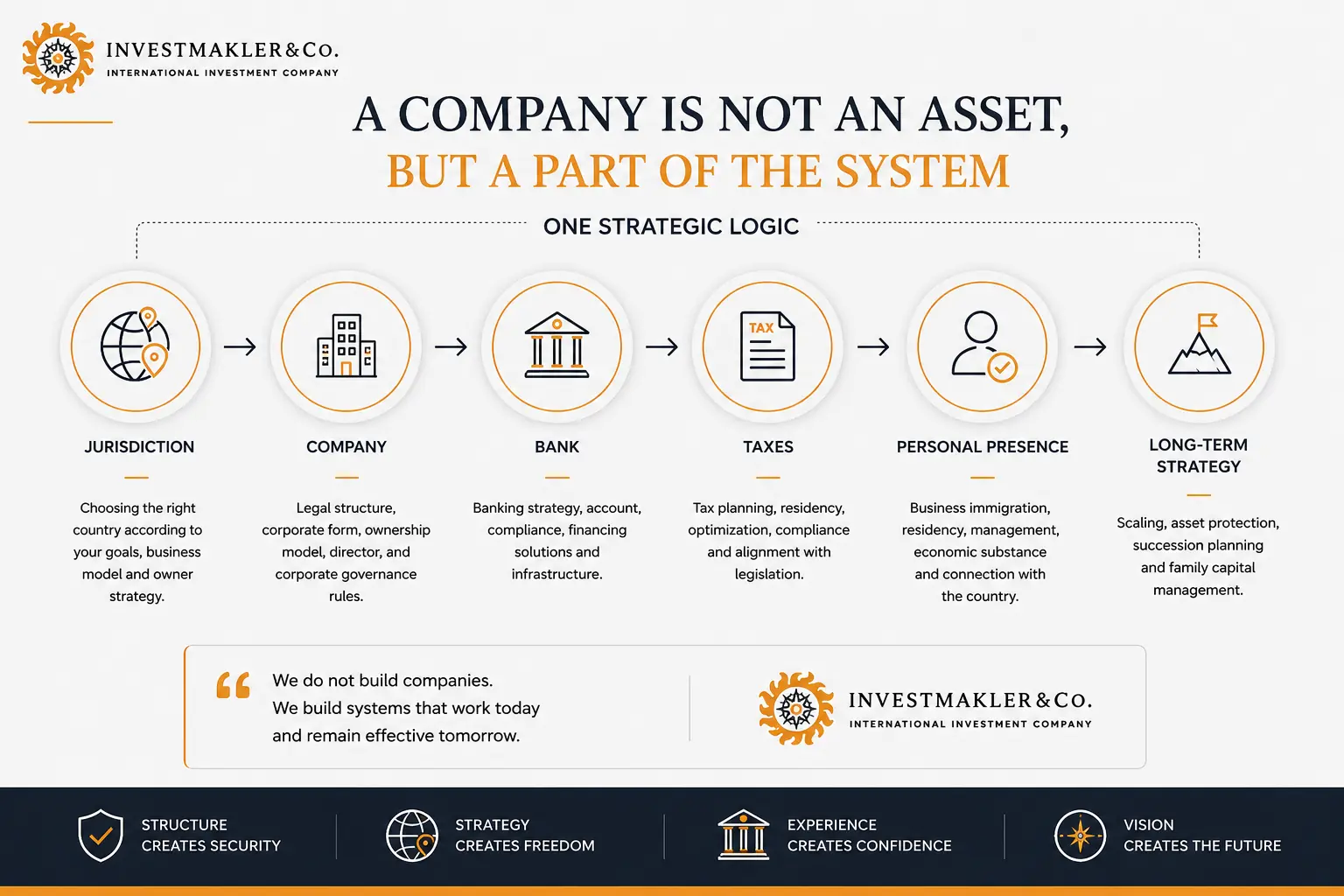
There is no universal jurisdiction for international business.
A corporate structure that perfectly supports one project may be entirely unsuitable for another. For this reason, we do not view company incorporation as an isolated legal service. We see it as one element of a broader international business strategy.
For us, company registration is a legal instrument.
The real value lies in building a corporate structure that integrates business objectives, banking strategy, tax planning, economic substance, shareholder interests and long-term business development into one coherent system.
This approach enables the creation of international structures that remain effective not only today, but for decades to come.
We do not begin with a predetermined jurisdiction.
Our role as a strategic partner is to understand the business, identify its actual requirements and determine the jurisdiction that naturally supports its long-term commercial objectives.
For one project, that jurisdiction may be Italy.
For another, it may be Germany, Switzerland, Poland, the United Arab Emirates or a different international jurisdiction.
The principle remains the same.
The jurisdiction should support the business.
The business should never be forced to adapt to the jurisdiction.
We believe that strong international corporate structures begin with the right questions.
What commercial function should the company perform?
How should the banking strategy be designed?
What tax framework best supports the business?
How should the corporate structure evolve over the next ten, twenty or several decades?
The answers to these questions create the foundation of sustainable international business.
For this reason, our work begins long before the incorporation process.
We assist clients in developing corporate architecture, designing banking strategies, preparing for compliance procedures and building international structures capable of supporting long-term commercial growth.
This approach helps prevent a substantial number of strategic, banking and corporate risks before the project enters the implementation stage.
We view international business as an integrated system.
Every element within that system should perform a clear commercial function while supporting the effectiveness of the structure as a whole.
Only then does a company become more than a legal entity.
It becomes a sustainable international platform for long-term business development.
The foundation of our model is the development of international corporate structures that integrate business strategy, banking, taxation, governance, shareholder interests and long-term growth into one coherent system. This is how sustainable international businesses are built—structures that remain commercially relevant and strategically effective for decades.